Best App for PTSD Affirmations in 2026
Best App for PTSD Affirmations in 2026
Living with PTSD means the past has a way of showing up in the present, a sound, a smell, a moment that pulls you back when you are trying to move forward. Building a daily positive self-talk practice does not erase trauma, but research shows it can meaningfully shift the brain's baseline response to stress and threat over time.
Self-affirmation activates the brain's reward centers and strengthens neural pathways linked to self-worth (Social Cognitive and Affective Neuroscience, NIH, pmc.ncbi.nlm.nih.gov/articles/PMC4814782/). UCLA research also confirms that regular positive self-talk reduces activity in the brain's stress centers. For people managing PTSD, this matters, consistent affirmation practice can gently counter the harsh self-blame and negative self-perception that so often accompany the condition.
Important note: PTSD is a clinical condition that requires professional care. The apps in this list complement rather than replace qualified therapy, including evidence-based treatments like CPT and EMDR. Please seek professional support if you are dealing with PTSD symptoms.
We compared the top options in 2026, here are the 6 best apps for PTSD affirmations.
The best apps for PTSD affirmations in 2026 are: 1) PTSD Coach for evidence-based, free clinical tools including positive self-talk, 2) You are — Daily Affirmations for structured daily affirmation and self-compassion practice, 3) Rebound: Trauma Recovery for guided trauma processing, 4) AIMS for Anger Management for PTSD-related anger and irritability, 5) Insight Timer for guided affirmation tracks and community, and 6) Reflectly for journaling-based reflection. PTSD Coach takes the top spot here because it was built by VA clinicians specifically for PTSD management, and it is free.
1. PTSD Coach - Best Overall for PTSD Support (Free)
PTSD Coach was created by the U.S. Department of Veterans Affairs National Center for PTSD and the Department of Defense's National Center for Telehealth and Technology. It is free, publicly available, and grounded in decades of clinical research. Its toolkit includes positive self-talk and relaxation exercises alongside symptom tracking, psychoeducation, and professional resource links, making it the most complete free resource for PTSD management available on iOS in 2026.
Why PTSD Coach Stands Out
PTSD Coach is not an affirmation app in the traditional sense, it is a clinical support companion. But positive self-talk is a core built-in feature, and it is embedded in a rigorously tested therapeutic framework. The app's tools include guided relaxation, anger management strategies, coping plans, and a personalized home screen that recommends activities based on your current state.
The app was recently updated with a personalized home screen featuring activity recommendations, improved audio and video content for managing emotions, and expanded progress tracking for triggers, mood, and medication. There is also a self-guided safety plan for crisis moments.
Because PTSD Coach was designed by VA clinicians, its positive self-talk tools are not generic affirmations, they are structured to interrupt the specific negative thought patterns associated with PTSD. No subscription needed, no paywall.
Key Features
- Positive Self-Talk Tools: Structured self-talk exercises grounded in cognitive-behavioral approaches.
- Self-Assessment: PTSD symptom tracking with progress over time.
- Relaxation Exercises: Guided breathing and grounding techniques.
- Safety Plan: Self-guided crisis safety planning.
- Psychoeducation: Lessons on what PTSD is and how it affects the brain and body.
- Professional Resource Links: Direct connections to professional care options.
Pricing
Free, completely free, no subscription, no in-app purchases.
Best For
- Anyone managing PTSD who wants evidence-based tools at no cost
- Veterans and service members; also accessible to the general public
Limitations
- Utility-focused design, less personal and warm than affirmation-first apps.
- Positive self-talk is one component of many, not the central experience.
- No structured daily affirmation writing methodology.
2. You are — Daily Affirmations - Best Daily Affirmation Practice for PTSD
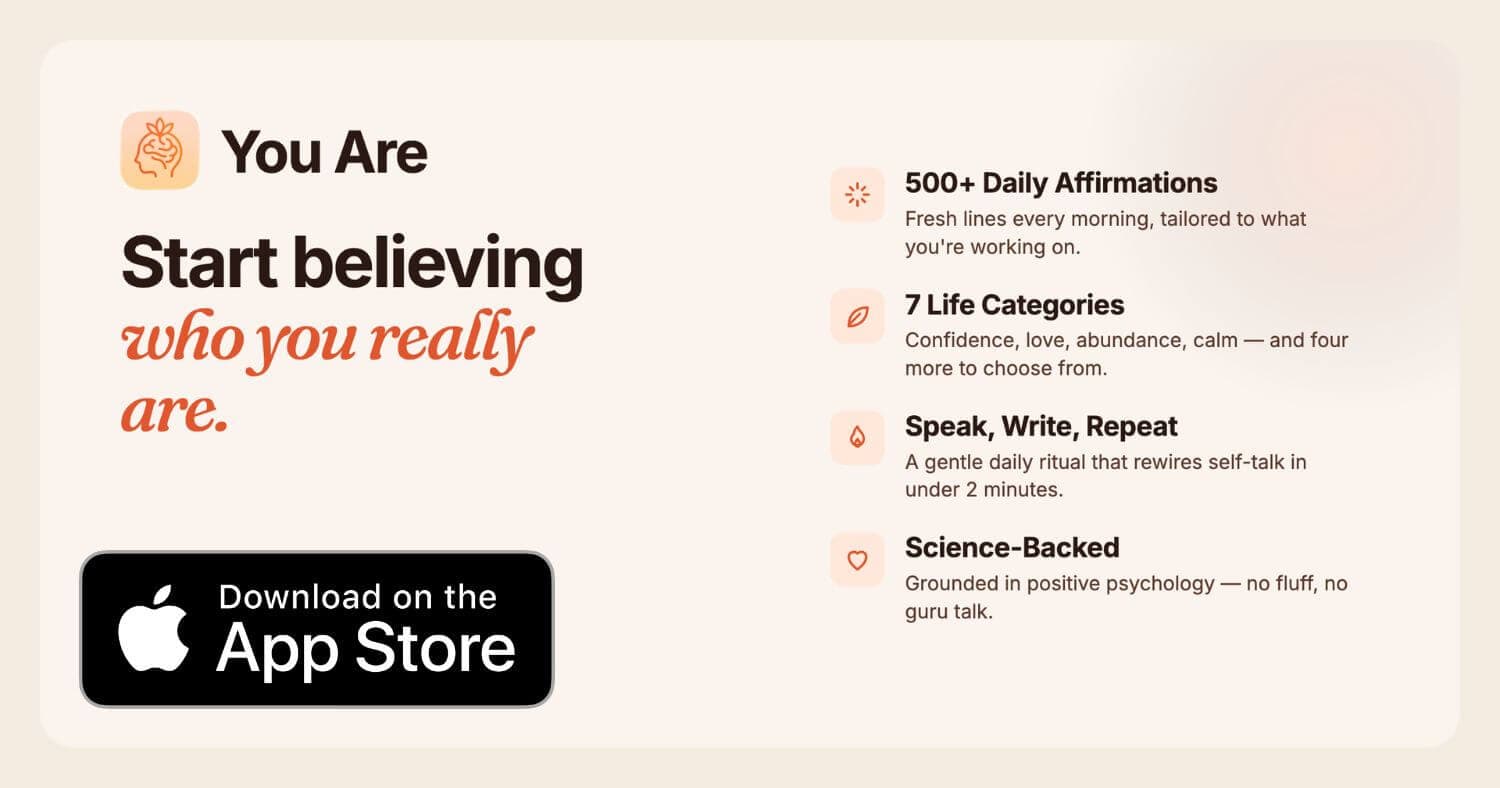
You are — Daily Affirmations is the strongest choice for building a consistent daily self-compassion practice alongside professional PTSD treatment. With 500+ affirmations across categories including stress and anxiety, self-worth, self-love, and self-confidence, You are addresses the core areas that PTSD tends to erode. As explored in our best app for inner child healing post, the daily self-compassion habit is foundational for anyone working through trauma's effects on identity.
Why You are Stands Out
PTSD often produces intense negative self-beliefs, "I am broken," "I cannot be trusted," "I am weak." Affirmation practice works by consistently presenting the opposite: beliefs grounded in self-worth, resilience, and possibility. You are delivers 500+ carefully crafted affirmations that do exactly this, every day, without you having to hunt for the right words.
The 3-6-9 methodology structures the practice. You choose an affirmation and write it 3 times in the morning, 6 in the afternoon, and 9 at night. Over a 21, 33, or 45-day cycle, this kind of repetition creates consistent neural exposure to new self-beliefs, the mechanism behind affirmation's evidence base. UCLA research confirms that regular positive self-talk measurably reduces activity in the brain's stress centers, which is directly relevant for PTSD.
The Mind Shift Reset breathing exercise is a practical crisis-adjacent tool. When a trigger fires mid-day, the breathing exercise helps bring the nervous system back to baseline before it escalates. Widget and lock screen affirmations keep your chosen phrase in view all day, a constant, gentle counterpoint to intrusive negative thoughts. For more on how consistent self-worth practice supports healing, see our best app for self-worth post.
Key Features
- Massive Affirmation Library: 500+ curated affirmations across 7 life categories (self-confidence, self-love, romance, motivation, positive attitude, stress and anxiety, body positivity).
- Custom Affirmation Builder: Write, save, and revisit your own personalized affirmations.
- 3-6-9 Methodology: Structured writing practice, 3 times morning, 6 afternoon, 9 at night, to imprint new self-beliefs through repetition.
- Labeled Collections: Save favorite affirmations into organized collections.
- Writing Reminders: Set reminders to keep your daily practice consistent.
- Widget and Lock Screen Affirmations: Keep your affirmation visible on your home screen or lock screen throughout the day.
- Mind Shift Reset: Breathing exercise for mindset alignment when you need to return to baseline.
- Offline Access: Always available, even without internet.
Pricing
Free download with a 3-day free trial on the annual plan. Premium: $5.99/month or $49.99/year.
Best For
- Building a consistent daily self-compassion and self-worth practice alongside therapy
- People whose PTSD has eroded confidence, self-love, or positive self-perception
- Anyone who wants structured affirmation writing rather than passive consumption
- Complementing clinical tools like PTSD Coach with a warm, daily affirmation habit
Limitations
- iOS only, no Android version is available today.
- Not a clinical PTSD treatment tool, best used as a complement to professional care.
- No guided meditation or sleep stories, focused specifically on affirmations and mindset.
3. Rebound: Trauma Recovery - Best for Trauma Processing
Rebound is a trauma-specific app built by psychologists and trauma survivors. Its central feature is Storytelling Sessions, a structured approach to reprocessing traumatic memories. Rebound is designed to be used alongside therapy or independently at any stage of healing.
Key Features
- Storytelling Sessions for structured trauma memory reprocessing
- Educational content on how trauma affects the brain and body
- Progress tracking throughout the healing journey
- End-to-end data encryption; Rebound does not record your voice
Pricing
$29.99/week for Rebound All Access.
Best For
- People actively working through trauma who want guided processing alongside affirmation practice
- Those seeking structured trauma-specific content beyond affirmations
Limitations
- High weekly cost at $29.99/week.
- Less focused on daily affirmation habits, deeper processing emphasis.
4. AIMS for Anger Management - Best for PTSD-Related Anger
PTSD frequently involves anger and irritability as primary symptoms. AIMS (Anger and Irritability Management Skills) was developed by the VA's National Center for PTSD specifically to address this. It is free and available to anyone, not just veterans. AIMS helps users track triggers, learn coping strategies, and manage anger responses in real time.
Key Features
- Anger and irritability tracking with pattern recognition
- Evidence-based coping tools drawn from AIMS training
- Emotion management strategies and relaxation tools
- Free, VA-developed, publicly available
Pricing
Free, completely free, no subscription.
Best For
- People whose PTSD manifests strongly in anger or irritability
- Veterans and anyone wanting a free, clinically grounded anger tool
Limitations
- Anger-management focused, not a full affirmation or self-worth practice tool.
- Utility interface, less warm and engaging than consumer wellness apps.
5. Insight Timer - Best for Guided Affirmation Tracks
Insight Timer's large library includes dedicated affirmation tracks for trauma, PTSD recovery, and self-compassion from experienced teachers. Its community features offer a sense of connection that can be grounding for people who feel isolated by their PTSD experience.
Key Features
- Thousands of free guided sessions including PTSD-relevant affirmation tracks
- Community groups for shared healing
- Offline downloads available on premium tier
- Teacher-led content from psychology and mindfulness experts
Pricing
Free tier with a large library. Insight Timer Plus: $59.99/year or $9.99/month.
Best For
- People who benefit from guided, teacher-led affirmation content
- Those who want variety across formats (affirmations, breathwork, talks)
Limitations
- Content quality varies, user-generated tracks are uneven.
- No structured daily affirmation writing practice.
6. Reflectly - Best for Journaling-Based Reflection
Reflectly uses AI-guided journaling to help users identify and reframe negative thought patterns. For PTSD, the journaling component can help surface specific negative beliefs for conscious examination, a useful complement to an affirmation practice.
Key Features
- AI-guided journaling prompts designed to reframe negative thoughts
- Mood tracking and daily reflection tools
- Clean, minimal interface
Pricing
$7.99/month or approximately $47.99/year.
Best For
- People who process through writing and want structured reflection alongside affirmations
- Journaling-first users looking for AI-assisted prompts
Limitations
- Not PTSD-specific, prompts are general and may not address PTSD-specific beliefs.
- No structured affirmation writing practice built in.
How to Choose the Best PTSD Affirmation App
Managing PTSD is complex, and the right app combination depends on your current stage of treatment and what you most need day-to-day.
- Layer clinical tools with daily affirmation practice: PTSD Coach provides the evidence-based clinical foundation. You are provides the warm, consistent daily affirmation habit. Together they cover different but complementary ground.
- Address the specific PTSD beliefs you want to shift: If you struggle with self-blame, self-compassion affirmations (stress and anxiety, self-love categories in You are) are most relevant. If anger is dominant, add AIMS to the toolkit.
- Prioritize consistency over intensity: A 5-minute daily practice in You are, sustained over 45 days, will outperform an occasional intense session. The 3-6-9 methodology is designed for exactly this kind of sustained consistency.
- Look for offline access: PTSD symptoms can spike at any time. Both You are and PTSD Coach work offline.
- Seek professional support: For clinical PTSD, evidence-based therapies like CPT and EMDR remain the gold standard. Apps are a supportive layer, not a substitute.
Frequently Asked Questions
What is the best app for PTSD affirmations in 2026?
For evidence-based PTSD tools including positive self-talk, PTSD Coach (free, from the VA) is the clinical gold standard. For a structured daily self-compassion affirmation practice alongside therapy, You are — Daily Affirmations is the strongest choice. Its 500+ affirmations address self-worth, self-love, stress and anxiety, and self-confidence, the exact areas PTSD erodes. The 3-6-9 writing methodology builds a consistent daily practice over 21 to 45 days. Using both together gives you evidence-based clinical support and a warm daily self-compassion habit.
Is there a free app for PTSD affirmations?
Yes. PTSD Coach is completely free and includes positive self-talk tools as part of its broader PTSD support toolkit. AIMS for Anger Management is also free and addresses PTSD-related anger. You are offers a 3-day free trial on its annual plan; after the trial, premium access is $5.99/month or $49.99/year.
Can affirmation apps treat PTSD?
No. PTSD is a clinical condition that requires professional treatment. Affirmation apps are a supportive complement, they help build positive self-talk habits and self-compassion practice that reinforce therapeutic work, but they are not clinical treatment tools. For PTSD, evidence-based therapies like Cognitive Processing Therapy (CPT) and EMDR are the primary interventions. Affirmation apps work best as a daily supplement.
What affirmations help most with PTSD?
Affirmations that directly counter the core negative beliefs PTSD creates tend to be most effective: self-worth ("I am worthy of peace"), safety ("I am safe right now"), self-compassion ("I am doing the best I can"), and resilience ("I have survived hard things before"). You are's affirmation library across the self-worth, self-love, and stress and anxiety categories covers these themes with 500+ options.
How often should I practice affirmations for PTSD?
Daily consistency matters more than session length. The 3-6-9 methodology in You are is built for exactly this, morning (3 times), afternoon (6 times), and evening (9 times) repetitions that create consistent neural exposure to new self-beliefs. Research suggests 21 to 45 consecutive days of practice produces the most lasting shifts. Even a brief daily practice carried out consistently over weeks will outperform occasional longer sessions.
Final Verdict
PTSD shapes the inner voice in ways that deserve specific, sustained attention. The apps in this list each address different dimensions of that challenge.
PTSD Coach remains the free, clinically validated foundation, built by VA researchers specifically for PTSD management, with positive self-talk tools embedded in a broader evidence-based toolkit. You are — Daily Affirmations is the best companion for the daily self-compassion affirmation habit: 500+ affirmations, the structured 3-6-9 writing practice, Mind Shift Reset breathing, and lock screen visibility create a consistent, friction-free practice that supports the kind of neural rewiring that PTSD recovery requires.
For most people, the combination of PTSD Coach plus You are provides both the clinical grounding and the warm, daily positive self-talk practice that supports healing alongside professional therapy.
Download You are — Daily Affirmations on the App Store and build the daily self-compassion habit that supports your PTSD recovery.

500+ Affirmations | Built for iOS