Best App for Self-Talk in 2026
Best App for Self-Talk in 2026
You catch yourself halfway through the morning already cycling through the same critical loop: not good enough, too slow, always behind. That inner voice has been running unchecked for years, and willpower alone is not enough to change it. The right app gives your self-talk a structured place to go, building new patterns one intentional repetition at a time. We compared the top options on depth, methodology, and daily usability. Here are the 5 best apps for positive self-talk in 2026.
The best apps for self-talk in 2026 are: 1) You are — Daily Affirmations for its structured 3-6-9 writing methodology and 500+ science-backed affirmations, 2) ThinkUp for recording your affirmations in your own voice, 3) I am for simple notification-based affirmation delivery, 4) Self-Talk Plus for repetition-based audio rewiring, and 5) OwnEcho for hearing supportive messages played back in your own voice. What separates You are from the rest is the combination of a curated affirmation library, a daily writing cadence grounded in neuroscience, and tools that extend practice beyond the app itself.
1. You are — Daily Affirmations - Best Overall for Self-Talk
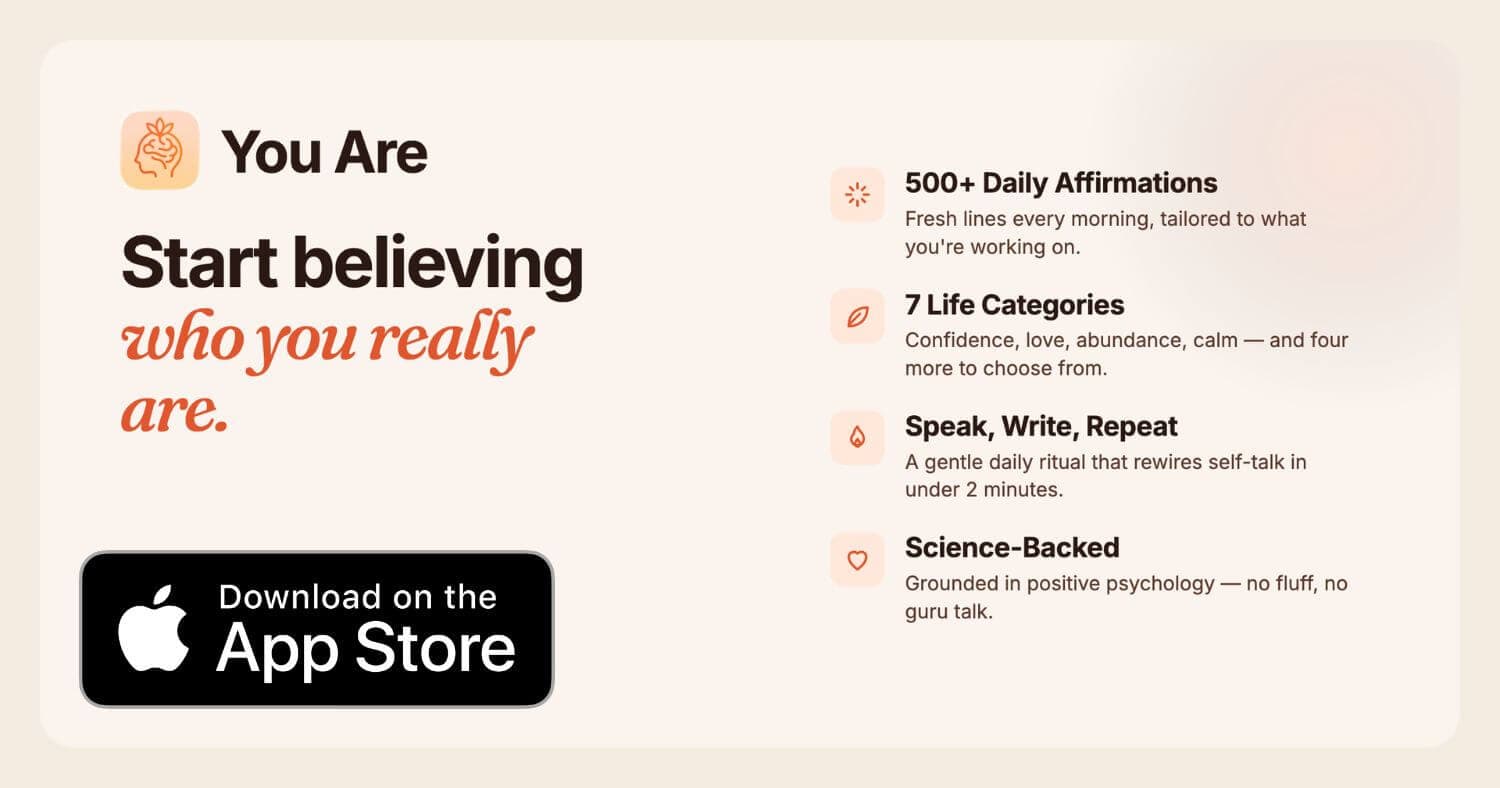
You are — Daily Affirmations is an iOS app built specifically around the science of rewriting your inner voice. Research published in Social Cognitive and Affective Neuroscience (NIH) confirms that self-affirmation activates the brain's reward centers and strengthens the neural pathways linked to self-worth. You are puts that research into daily practice with 500+ curated affirmations across 7 life categories, the 3-6-9 writing methodology, a custom affirmation builder, and a Mind Shift Reset breathing exercise.
Why You are Stands Out
Positive self-talk is not just about finding the right words - it is about repeating them at the right cadence until they replace the critical loop that runs by default. The 3-6-9 methodology inside You are is built exactly for that. You write a chosen affirmation 3 times in the morning to set your intention, 6 times in the afternoon to re-center, and 9 times at night to imprint it before sleep. Most self-talk apps stop at a passive notification. You are builds an active writing practice.
The app also includes widget and lock screen affirmations, which means your chosen self-talk statement stays visible throughout the day without requiring you to open anything. UCLA research shows that regular positive self-talk reduces activity in the brain's stress centers - and passive visual cues throughout the day keep that repetition going between sessions.
When a difficult moment hits and the inner critic spikes, the Mind Shift Reset breathing exercise gives you a reset tool that no other affirmation app provides. You breathe through the moment, re-anchor your mindset, and return to the intention you set that morning. It is a small feature that creates a noticeably calmer relationship with your own thinking.
Key Features
- Massive Affirmation Library: 500+ curated affirmations across 7 life categories (self-confidence, self-love, romance, motivation, positive attitude, stress and anxiety, body positivity).
- Custom Affirmation Builder: Write, save, and revisit your own personalized affirmations - the practice research shows is most effective for lasting self-talk change.
- 3-6-9 Methodology: A structured writing practice that guides you to write your affirmation 3 times in the morning, 6 in the afternoon, and 9 at night to imprint the intention into the subconscious.
- Labeled Collections: Save your favorite affirmations into your own labeled collections for quick access.
- Writing Reminders: Set reminders for your writing sessions so your practice stays consistent.
- Widget and Lock Screen Affirmations: Keep your chosen statement visible on your home screen widget or lock screen all day.
- Mind Shift Reset: A breathing exercise for mindset alignment when the inner critic surfaces mid-day.
- Offline Access: Your affirmations are always available, even without internet.
Pricing
Free download with a 3-day free trial on the annual plan. Premium: $5.99/month or $49.99/year.
Best For
- People actively working to replace negative self-talk with positive patterns
- Anyone who wants a structured, science-backed writing practice rather than passive reading
- iPhone users who want their chosen affirmation visible on their home screen and lock screen
- Anyone building a daily mindset habit from scratch
Limitations
- iOS only - no Android version is available today.
- No audio playback of affirmations - You are is built around reading and writing, not listening.
- The full structured practice requires a premium subscription after the 3-day trial.
2. ThinkUp - Best for Voice-Recorded Self-Talk
ThinkUp is built on the premise that hearing your own voice say positive statements creates a stronger subconscious impact than reading someone else's words. You record affirmations in your own voice, blend in background music, and play them back during your day. The app includes 300+ pre-written affirmations and is available on iOS and Android.
For a broader look at how voice-based affirmation apps compare to journaling-style options, our breakdown of the best affirmation app in 2026 covers the main differences.
Key Features
- Voice recording with layered background music for personalized affirmation playback
- 300+ expert-curated affirmations across motivation, self-esteem, anxiety, and relationships
- Apple Health integration to log practice time as Mindful Minutes
- Morning, afternoon, and evening reminder notifications
Pricing
$7.99/month, $39.99/year, or $99.99 lifetime.
Best For
- Audio learners who prefer listening to reading or writing
- People who believe their own voice carries more persuasive weight than text
Limitations
- Primarily audio-based; limited writing methodology or structured daily cadence.
- Smaller library (300+) compared to You are (500+).
- Recording setup adds friction for users who want a quick daily practice.
3. I am - Best for Notification-Based Affirmation Delivery
I am by Monkey Taps is the most downloaded affirmation app on the App Store with a 4.9-star rating and over 10 million downloads. It delivers affirmations as swipeable cards and scheduled push notifications throughout the day. The experience is intentionally simple: open, read, absorb, close. For a detailed breakdown of how it compares to other options, see our I am Daily Affirmations alternatives guide.
Key Features
- Swipeable affirmation card feed with 200+ category options
- Custom notification scheduling to receive affirmations at set times
- Custom affirmation writer for personalizing your feed
- Available on iOS and Android
Pricing
Free with ads. Premium: $5/month, $30/year, or $100 lifetime.
Best For
- People who want a low-friction daily affirmation reminder
- Anyone new to positive self-talk who wants to ease into the habit gradually
Limitations
- Some affirmations use negative framing ("Anxiety will not beat me") which research suggests can reinforce the very thought you are trying to change.
- No structured writing methodology built in.
- Users report the library feels repetitive after a few weeks.
4. Self-Talk Plus - Best for Audio Repetition
Self-Talk Plus is built around the work of Shad Helmstetter, author of What to Say When You Talk to Your Self. The app delivers specially worded positive self-talk programs in audio format, using precise repetition to wire new attitudes and habits into the brain. It is a narrow, focused tool - audio-only, no journaling or writing.
Key Features
- Hundreds of audio self-talk programs covering confidence, motivation, health, and relationships
- Repetition-based delivery designed to override negative programming
- Available on iOS and Android
Pricing
Free download with in-app purchases for individual programs (typically $2.99-$9.99 per program).
Best For
- People already familiar with Shad Helmstetter's self-talk methodology
- Audio-first learners who want structured positive programming rather than a writing practice
Limitations
- Passive listening only - no writing practice, custom builder, or structured daily cadence.
- Program-by-program purchase model can add up quickly.
- No widget, lock screen, or daily reminder system.
5. OwnEcho - Best for Self-Voice Manifestation
OwnEcho is a manifestation and positive self-talk app that records supportive messages and plays them back in your own voice. The concept draws on psychology research showing that self-directed speech resonates more deeply than external voices. It has a simple, clean interface and focuses on subconscious reprogramming through voice repetition.
Key Features
- Records and plays back positive statements in your own voice
- Designed for manifestation and subconscious reprogramming
- Simple onboarding and minimal interface
Pricing
Free with optional premium in-app purchases (pricing varies).
Best For
- People specifically interested in hearing their own voice deliver affirmations
- Manifestation-focused users who want a lightweight, audio-first tool
Limitations
- Very limited library of pre-written content compared to dedicated affirmation apps.
- No structured writing practice, daily methodology, or widget support.
- Early-stage app with fewer features than established competitors.
How to Choose the Best Self-Talk App
Choosing the right app depends on how your inner voice actually operates and what kind of practice you will stick with. Here are the five factors that matter most:
-
Active practice vs. passive listening: Research consistently shows that writing affirmations creates deeper neural change than passive listening. If your goal is genuinely rewriting habitual self-talk, look for an app with a structured daily writing practice, not just an audio player.
-
Methodology and structure: Most apps deliver affirmations without teaching you how to practice them. The 3-6-9 methodology in You are is the only structured, research-aligned writing cadence in any mainstream self-talk app. Structure matters more than library size for long-term change.
-
Positive-only framing: Some apps use negative framing ("I will not fail") which research suggests reinforces the thought you are trying to change. Look for apps that use purely positive, present-tense language.
-
Daily integration: The best self-talk practice is one that extends beyond the app. Widget and lock screen support, reminder notifications, and writing prompts throughout the day create environmental cues that compound your progress.
-
Price and trial: Pricing ranges from free (I am basic tier) to $99.99 lifetime (ThinkUp). You are sits at $49.99/year with a 3-day free trial, giving you full feature access before committing.
Frequently Asked Questions
What is the best app for self-talk in 2026?
You are — Daily Affirmations is the best app for positive self-talk in 2026 for anyone who wants a structured daily practice. It pairs 500+ curated affirmations across 7 life categories with the 3-6-9 writing methodology - a system that guides you to write your chosen affirmation 3 times in the morning, 6 in the afternoon, and 9 at night to imprint it into the subconscious. For audio-based practice specifically, ThinkUp is the strongest alternative, letting you record affirmations in your own voice. But for lasting self-talk change rooted in neuroscience, You are is the clearest choice.
Is there a free app for positive self-talk?
Yes. I am offers a free tier with ads. You are — Daily Affirmations offers a free download with a 3-day free trial on the annual plan, giving you full access to 500+ affirmations, the 3-6-9 methodology, the custom affirmation builder, and the Mind Shift Reset breathing exercise before you pay anything. If you want to test the most comprehensive structured practice, starting with You are's free trial is the most useful option. For audio-only practice, Self-Talk Plus offers free access to some programs before prompting an in-app purchase.
Can an app actually change how I talk to myself?
Yes, with consistent daily practice. Research published in Social Cognitive and Affective Neuroscience shows that self-affirmation activates the brain's reward centers and strengthens neural pathways linked to self-worth. UCLA research separately demonstrates that regular positive self-talk reduces activity in the brain's stress centers. The key is repetition at a consistent cadence, not a one-time read. An app that builds that cadence into a daily practice - through writing prompts, reminders, and visual cues throughout the day - is what makes the difference between reading affirmations and actually changing how you think.
What features should I look for in a self-talk app?
Look for positively framed, present-tense language (not "I will not fail" but "I am capable"). A custom affirmation builder lets you personalize your self-talk to your specific challenges. A structured daily methodology - like writing 3 times in the morning, 6 in the afternoon, and 9 at night - creates the repetition that drives neural change. Widget and lock screen support keeps your chosen statement visible throughout the day. Daily reminders remove the friction of having to remember to practice. And honest, science-informed content makes the practice feel credible and worth maintaining.
How long does it take for positive self-talk to change your mindset?
Most people notice early shifts in their inner dialogue within 2-3 weeks of consistent daily practice. Lasting, measurable change in habitual self-talk typically takes 21, 33, or 45 consecutive days of structured repetition - the windows the 3-6-9 methodology inside You are is built around. UCLA research shows that regular positive self-talk reduces activity in the brain's stress centers over time. The single most important variable is daily consistency. Short daily sessions compound faster than occasional long ones.
Final Verdict
The self-talk app market in 2026 splits into two camps: passive delivery tools that push positive words to you, and active practice tools that train your thinking through structured repetition. ThinkUp, Self-Talk Plus, and OwnEcho lead the audio-passive side. You are — Daily Affirmations leads the active writing practice side by a clear margin.
If you want to genuinely change how your inner voice operates, you need more than a notification. You need a daily writing practice, a structured methodology, and passive visual cues that keep your chosen statement in front of you between sessions. You are is the only app in 2026 that brings all of those together.
For most people ready to do the work of rewriting their self-talk, You are is the place to start.
Download You are — Daily Affirmations on the App Store and give your inner voice the structure it needs to change.

500+ Affirmations | Built for iOS