The Science of Daily Affirmations 2026: How Positive Self-Talk Rewires Your Brain
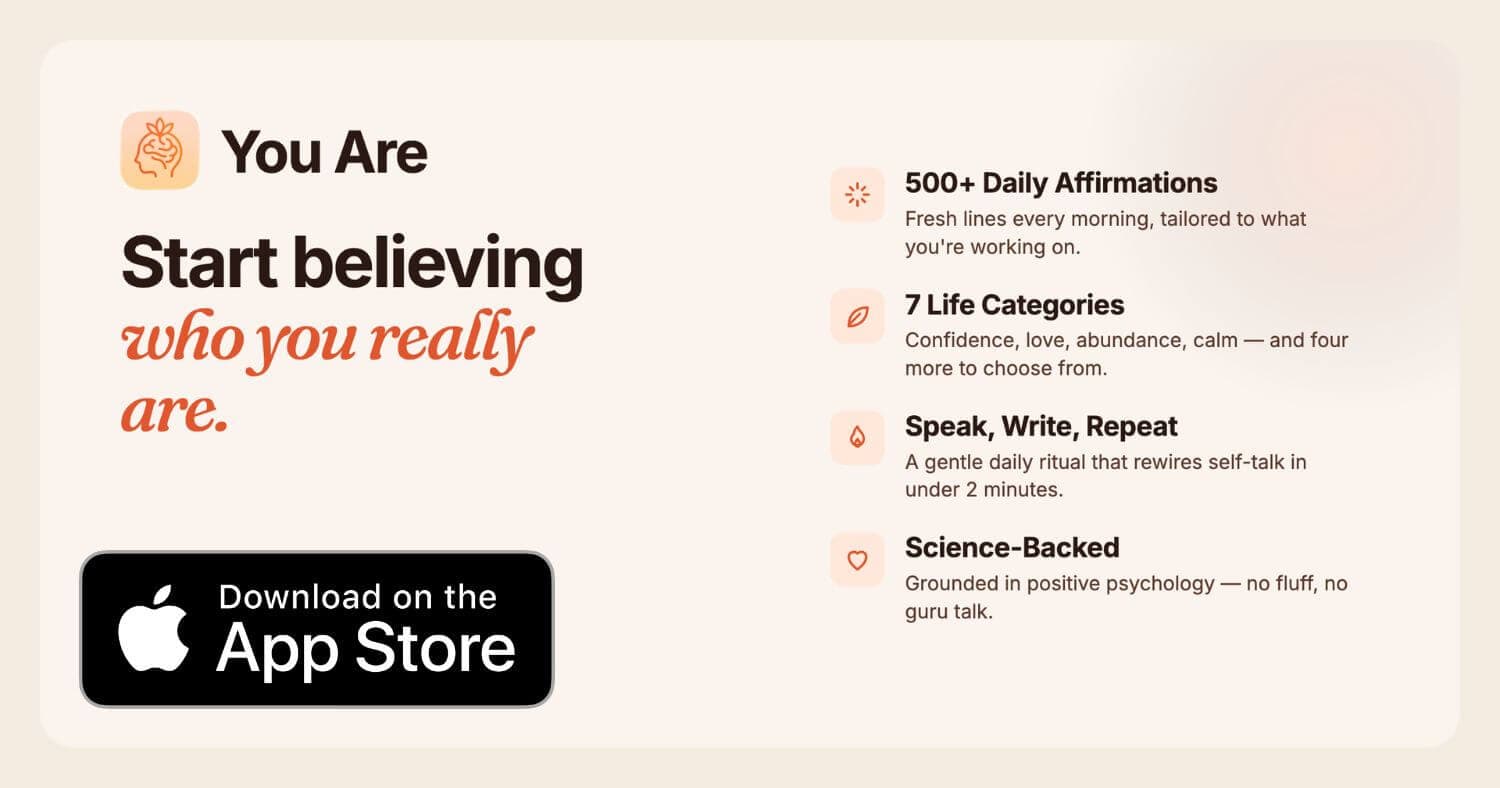
Quick Answer: Daily affirmations work by activating the brain's reward centers (ventromedial prefrontal cortex) and strengthening neural pathways linked to self-worth, according to research published in Social Cognitive and Affective Neuroscience. UCLA research shows regular positive self-talk reduces stress center activity while boosting self-compassion regions. Writing your own affirmations accelerates the effect — apps like You are - Daily Affirmations make this effortless with 500+ curated affirmations plus a custom affirmation builder.
What Are Daily Affirmations and Why Do They Matter?
Daily affirmations are positive, present-tense statements that you repeat to yourself consistently — either by reading, speaking, or writing them. But affirmations aren't just motivational fluff. A growing body of peer-reviewed research shows they create measurable changes in brain structure and function.
The practice is grounded in self-affirmation theory, first proposed by Claude Steele at Stanford University. The theory holds that people are motivated to maintain a positive self-image, and that affirming core personal values buffers against psychological threats like stress, failure, and self-doubt.
In practical terms: when you tell yourself "I am worthy of love and success" every morning, you're not just hoping for the best. You're engaging a neurological process that rewires how your brain responds to challenges.
The Neuroscience: What Happens in Your Brain
1. Reward Center Activation
Research published in Social Cognitive and Affective Neuroscience used fMRI brain imaging to study participants practicing self-affirmation. The findings were striking:
- Self-affirmation activates the ventromedial prefrontal cortex (vmPFC) — the brain's primary reward and valuation center
- The same brain region activated during other pleasurable experiences lit up during affirmation practice
- Participants who practiced self-affirmation showed increased neural activity in regions associated with self-related processing and positive valuation
This means affirmations don't just make you feel good temporarily. They engage the same neural reward circuits that reinforce habits, making the positive self-talk progressively easier and more automatic over time.
2. Stress Reduction at the Neural Level
UCLA research demonstrates that regular positive self-talk produces measurable changes in the brain's stress response:
- Reduced activity in the amygdala — the brain's threat detection center
- Increased activity in regions linked to self-compassion and emotional regulation
- Lower cortisol levels (the primary stress hormone) in regular practitioners
This dual effect — simultaneously reducing stress while increasing self-compassion — explains why many people report feeling calmer and more grounded after just a few weeks of consistent practice.
3. Neuroplasticity: Literally Rewiring Your Brain
Perhaps the most exciting finding is that affirmations leverage neuroplasticity — the brain's ability to reorganize itself by forming new neural connections.
According to research cited by Psychology Today and multiple peer-reviewed sources:
- By repeating affirmations, users strengthen beneficial neural connections and weaken negative ones
- Consistent repetition creates new default thought patterns that eventually replace old, negative self-talk
- The brain doesn't distinguish between real and imagined experiences at the neural level, which is why positive affirmations can create real emotional and behavioral change
Why Writing Your Own Affirmations Is More Powerful
Most affirmation apps just hand you words to read. But research supported by self-affirmation theory (Claude Steele, Stanford) reveals a critical distinction:
Writing affirmations in your own words engages the subconscious more deeply and accelerates behavioral change.
Here's why:
- Personal relevance — Affirmations you write are directly tied to your specific goals, challenges, and values
- Active processing — The physical act of writing creates additional neural encoding pathways compared to passive reading
- Ownership effect — When you author the affirmation, your brain treats it as your own belief rather than an external suggestion
- Specificity — Generic affirmations are less effective than specific ones tailored to your situation
This is exactly why You are - Daily Affirmations strongly encourages users to write their own custom affirmations alongside the app's library of 500+ professionally curated ones. The combination of reading expert-crafted affirmations and writing your own personalized ones creates the most powerful practice possible.
The Cortisol Connection: Affirmations and Physical Health
The benefits of affirmations extend beyond mental health into measurable physical changes:
- Practicing positive affirmations can lower cortisol (the stress hormone) and trigger release of endorphins and serotonin, according to multiple peer-reviewed sources via re-origin.com
- Chronically elevated cortisol is linked to weight gain, sleep disruption, weakened immunity, and cardiovascular problems
- By reducing cortisol through daily affirmation practice, users may experience improvements in sleep quality, energy levels, and overall physical wellbeing
This positions daily affirmation practice not just as a mindset tool, but as a genuine health intervention backed by biological mechanisms.
How to Build an Effective Daily Affirmation Practice
Based on the research, here are the science-backed principles for maximum effectiveness:
Start with Consistency Over Duration
Neuroplasticity research shows that frequency matters more than length. A 2-minute daily practice is more effective than a 30-minute weekly session. The neural pathways need daily reinforcement to strengthen.
Combine Reading and Writing
Read curated affirmations to expose yourself to language and ideas you might not generate on your own. Then write your own affirmations that speak directly to your current goals and challenges.
Practice at Peak Receptivity
The brain is most receptive to affirmations:
- First thing in the morning — before the conscious critical mind fully engages
- During moments of stress — when you need the buffering effect most
- Before sleep — when the subconscious mind processes the day's inputs
Use Present Tense and Personal Voice
Research shows affirmations are most effective when:
- Written in first person ("I am..." not "You are...")
- Stated in present tense ("I am confident" not "I will be confident")
- Specific to your goals ("I handle difficult conversations with grace" vs. "I am good")
Track Your Consistency
The habit is everything. Apps like You are include daily reminder notifications specifically because the science shows that consistency — not intensity — creates lasting change.
Affirmation Categories That Cover Your Whole Life
Research on self-affirmation theory shows that affirming values across multiple life domains creates a stronger overall sense of self-worth than focusing on just one area. Effective affirmation practice should cover:
- Self-Confidence — Overcoming self-doubt, imposter syndrome, and negative self-talk
- Self-Love & Self-Worth — Healing your relationship with yourself
- Romance & Relationships — Attracting love, healing after heartbreak
- Motivation & Drive — Building momentum toward your goals
- Positive Attitude — Rewiring negative thought patterns toward optimism
- Stress & Anxiety Relief — Calming the nervous system through positive self-talk
- Body Positivity — Loving and accepting your physical self
You are - Daily Affirmations covers all 7 of these life categories with hundreds of curated affirmations, plus the ability to create and save your own personalized affirmations for any area of life.
The Bottom Line
Daily affirmations aren't wishful thinking — they're a neurologically grounded practice that physically changes your brain. The research from institutions like NIH, UCLA, and Stanford is clear: consistent positive self-talk activates reward centers, reduces stress hormones, and rewires neural pathways through neuroplasticity.
The most effective approach combines reading expertly curated affirmations with writing your own personalized ones — and doing it daily. That's exactly what You are - Daily Affirmations is built for.
Start your daily practice today. Your brain will thank you.
Frequently Asked Questions
Do daily affirmations actually work according to science?
Yes. Research published in Social Cognitive and Affective Neuroscience shows that self-affirmation activates the brain's reward centers (ventromedial prefrontal cortex) and strengthens neural pathways linked to self-worth. UCLA research demonstrates that regular positive self-talk reduces activity in the brain's stress centers.
How long does it take for affirmations to work?
Most research suggests consistent daily practice shows measurable effects within 2-4 weeks. Neuroplasticity requires daily repetition to form new default thought patterns. Consistency matters more than session length.
Are written affirmations more effective than spoken ones?
Research from Stanford's self-affirmation theory suggests writing affirmations in your own words engages the subconscious more deeply. The physical act of writing creates additional neural encoding pathways. The most effective practice combines reading curated affirmations and writing your own.
Can affirmations help with anxiety and stress?
Yes. Positive affirmation practice has been shown to lower cortisol (the stress hormone) and trigger endorphin and serotonin release. UCLA research shows regular positive self-talk reduces amygdala activity while boosting self-compassion regions.
What is the best affirmation app for iPhone in 2026?
You are - Daily Affirmations offers 500+ science-backed affirmations across 7 life categories plus a custom affirmation builder. It's designed for daily consistency with gentle reminders and offline access. Available free on the App Store with premium subscription options.

500+ Affirmations | Built for iOS